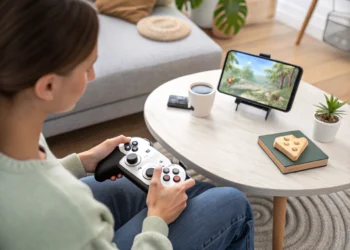
Some mobile games want your full attention. They rely on sound cues, fast reactions, dialogue, or constant reading. Others are perfect companions for music, podcasts, or background videos. You can play them with the sound off, follow a simple rhythm, and let your mind rest in two places at once.
This kind of game is useful for casual players because not every session needs to be immersive. Sometimes you want your hands busy while your ears are occupied. The right game gives you light interaction without stealing the whole room.
What makes a good second-screen game?
A good second-screen game is readable without audio. It should not require constant story attention, complex instructions, or tiny visual details that demand full focus. The controls should be simple enough that you can play while listening, but not so empty that you get bored after two minutes.
It also helps if the game has natural stopping points. If you are listening to a podcast and need to pause the game, you should not lose a battle or waste a timed event. Games with rounds, levels, boards, or idle collection usually work better than live multiplayer.
Puzzle and sorting games
Sorting games, tile-matching games, and simple logic puzzles are some of the best choices. They give your eyes and hands a pattern to follow while leaving your ears free. The repeated actions can even feel soothing, especially when the visuals are clean and the difficulty does not spike too sharply.
Word games are more complicated. Some are great for quiet focus, but they may compete with spoken audio because both use language. If you are listening to a conversation-heavy podcast, a color sorting game may be easier than a word puzzle.
Merge and idle games
Merge games can work well because they often involve organizing objects and completing small requests. Idle games also fit because they do not require constant attention. You collect, upgrade, check progress, and let things continue. These games are good when you want a soft routine beside music.
The risk is clutter. A merge game with too many event boards or an idle game with constant pop-ups can become distracting. The best second-screen picks keep the interface simple and let you understand the next action quickly.
Decoration and coloring games
If you prefer a creative mood, decoration, coloring, and design games can pair nicely with music. They do not always need sound, and they let you make visual choices at your own pace. This works especially well when you want to unwind rather than solve difficult problems.
Choose games that allow relaxed editing. If every design choice costs rare currency or every coloring page is interrupted by ads, the calm disappears. A second-screen game should feel like a companion, not a noisy salesperson.
Quick checklist
- Can the game be enjoyed with sound off?
- Does it avoid live multiplayer pressure?
- Are sessions easy to pause?
- Is the screen clean enough for casual attention?
- Does it use reading heavily while I am listening to speech?
This last point matters because attention is not unlimited. A story game may be wonderful, but it is usually not the best choice during a podcast. Save narrative games for moments when you can enjoy the writing. Use simpler games when your ears are already busy.
Why these games are worth keeping
Second-screen games are not lesser games. They serve a different purpose. They help during chores, commutes, quiet evenings, or moments when you want to listen without just staring into space. They give your hands a small, satisfying loop and make audio time feel more settled.
The best pick depends on what you listen to. Music pairs well with almost anything calm. Podcasts pair better with visual or pattern-based games. Audiobooks may need the simplest gameplay of all. Once you find the right match, a casual mobile game can become part of a comfortable routine: one level, one song, one episode, and a little pocket of ease in the day.
Match the game to the audio
Not every listening session needs the same game. Instrumental music pairs well with puzzles, decorating, or merge games. Conversation-heavy podcasts usually work better with visual games that do not involve much reading. Audiobooks may need the simplest game of all, because the story deserves most of your attention.
When the pairing is right, the game almost disappears into the rhythm of listening. Your hands have something light to do, but your mind is not split in an uncomfortable way. If you keep losing track of the audio or making mistakes in the game, the match is probably wrong, not you.
Another good sign is whether the game can be played comfortably with one hand. If you are listening while commuting, cooking, or resting, simple controls matter. A game that requires constant precision may fight the relaxed audio mood you were trying to create.